On September 8, 2025, 61 anti-corruption protesters in Nepal were killed by police. A day later, the parliament building was on fire. The prime minister resigned. Then, after a Discord poll for who would take charge closed, Sushila Karki, a former Nepalese Supreme Court justice, was inaugurated as interim prime minister.
The so-called “Gen Z revolution” was sparked by social media, with the children of politicians flaunting their wealth while 20% of the country lives in poverty. Online backlash transformed into protests when the government, under the justification of stopping disinformation, banned 26 social media platforms, including Instagram and YouTube.
Peaceful protests turned violent when a group of men with pickaxes charged the gates of parliament. Police opened fire, killing students and other non-violent protesters, including Dipendra Basnet, a married 28-year-old with a child. The government eventually overturned the social media ban, but after the death of friends and family, many wondered if it was worth it.
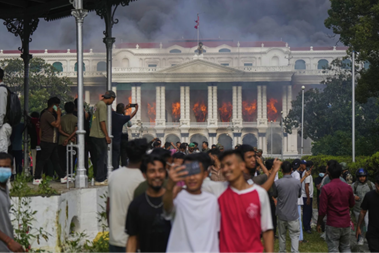
A day later, smoke appeared above the parliament building. Whether this was a truly spontaneous act of arson is still under investigation, but the writing was on the wall for the government: they lost control. The prime minister resigned, and the army entered the capital.
At the same time, a poll was opened in a discord server called “Youths against corruption,” asking who should be elected prime minister. Organized by Hami Nepal, a nonprofit relief organization, over 100,000 people heard debates held in discord voice channels and voted. Sushila Karki won with over 50% of the vote, with youtuber “Random Nepali” in second place, getting 25% of the vote.
Although a discord poll deciding the fate of a country makes for an interesting story, in reality, the new interim prime minister was ultimately chosen by the army and protest leaders. The head of Hami Nepal Mr. Gurung was offered the role, but Karki was given it after he refused.
With Karki as interim prime minister, parliament remains suspended while corruption investigations are underway. New elections are planned for March.
Far from the first revolution in Nepal, with one in 2008 abolishing the monarchy, the most recent overthrow is characterized by a lack of formal leadership. The decentralization of the movement is what gives many hope that real change will be made. As Piyush Adhikari, a Nepalese student, wrote, “the fatal flaw of all these (previous) revolutions lay in their leadership,” who eventually betray the movement.
Mr. Paul Doran, a Skyline teacher for IB history, cautioned that without a leader to represent the revolution, it is unlikely that real change will happen. But, he added, if a decentralized movement were to succeed, “it would happen in a smaller country like Nepal.”
Long-term change, what is desired by Nepalese protesters, is still uncertain. Karki is reportedly collaborating with the “old guard” while pushing out revolutionaries like Mr. Gurung. Collaboration with the “old guard” is necessary to a degree to keep “institutional memory,” Mr. Doran said, but it isn’t a great sign.
The future of Nepal is unknown, but it lies in the hands of the youth, if they choose to continue the fight.
For more information:
How a Gen Z Revolution Spiraled Out of Control
Nepal’s major parties say dissolved parliament must be reinstated
The Gen Z uprising in Asia shows social media is a double-edged sword
Nepal’s leaderless Gen-Z revolution has changed the rules of power
Unease at slow pace of change in Nepal one month on from gen Z protests