Since Skyline’s establishment in 1997, the Special Education Department has provided specialized instruction and support services to students with a wide range of learning differences and disabilities. Today, the department includes education teachers, a speech language pathologist, an occupational therapist, a physical therapist, a psychologist, and additional support staff.
There are two centers for special education in the Issaquah School District: Learning Resource Center I (LRCI), which supports students in academic, social, and behavioral areas, and Learning Resource Center II (LRCII), which supports students with moderate to severe disabilities in all areas.
Mrs. McIlwain is a Skyline special education teacher. She writes IEPs, which are individualized education plans for each student to be successful. She said that this year in LRCI, all students are in general education classes, and teachers are using the IEPs to help accommodate students with the resources needed to learn.
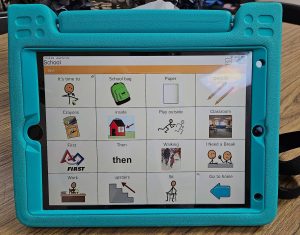
Augmentative and Alternative Communication devices (AACs) are another prominent accommodation some Skyline students use to help with nonverbal communication. These devices often use simple images and symbols as a support or replacement for spoken words.
Other staff in the Special Education Department include Ms. Chang, the speech-language pathologist, and Ms. Silvernail, the occupational therapist. Ms. Chang helps students with their communication skills, while Ms. Silvernail helps students learn how to perform everyday tasks.
“One of the biggest challenges is making sure each student gets the support that they need to succeed,” says Ms. Silvernail. Challenges include following directions, managing behavior, staff and peers not understanding various disabilities, and the individual biases and negative perceptions of various disabilities we all have.
The most important thing to remember is to be kind and show grace. Understanding that differences are okay and that people are often struggling with things that we may not understand.
“Open acceptance fosters a more welcoming environment and gives other students the courage to follow suit,” said Ms. Chang. Even if it’s a simple wave in the hallways, inclusion in activities, or showing an interest in learning about disabilities. Kindness, acceptance, and compassion go a long way.
For more information:
About Intellectual and Developmental Disabilities (IDDs)
Attention-Deficit/Hyperactivity Disorder (ADHD)
Autism and Education: One Size Does Not Fit All
Autism spectrum disorder: definition, epidemiology, causes, and clinical evaluation
Educational Interventions for Children and Youth with Autism: A 40-Year Perspective