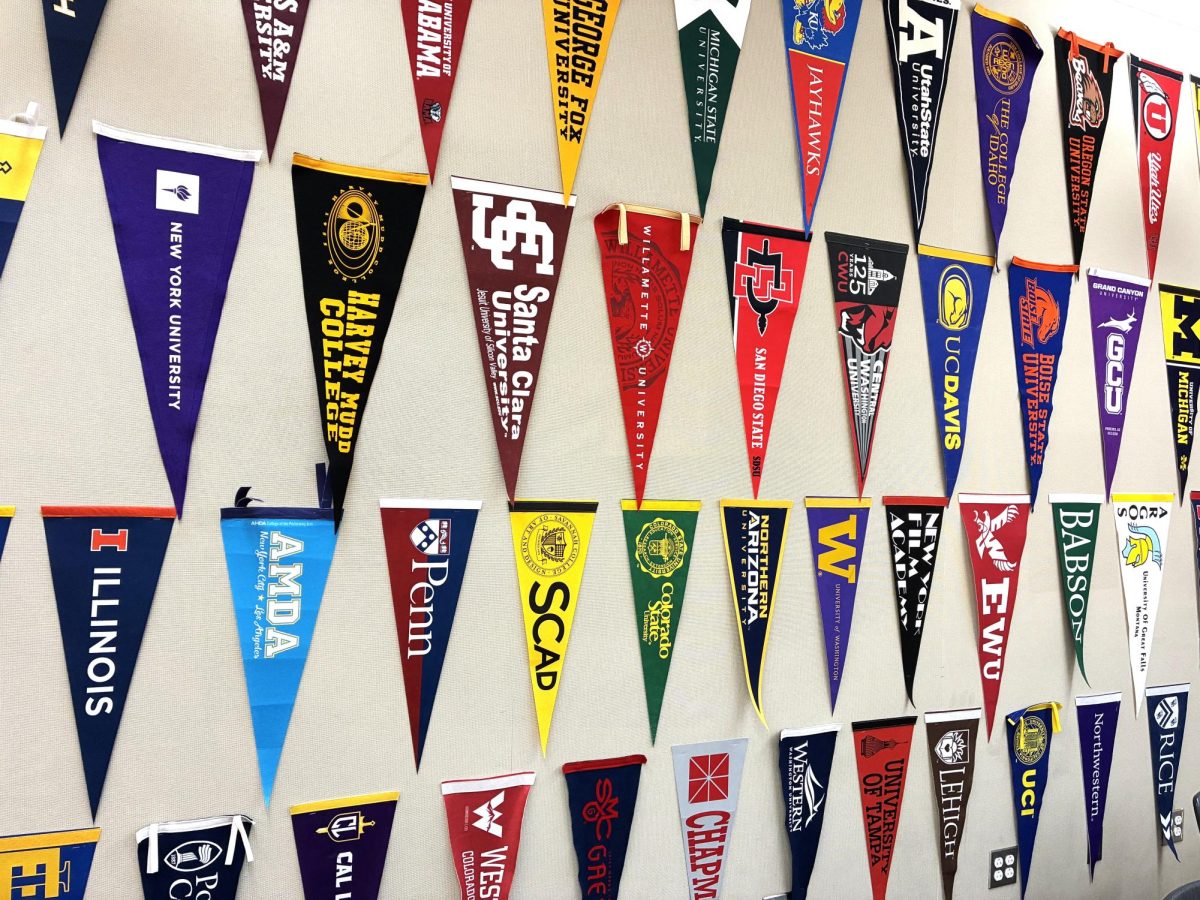
“Are you done with your college apps yet?” is a line almost every senior dreads to hear. With the application season nearing an end, it brings the question: Are college admissions fair?
The origins of holistic admissions, which try to focus on an applicant as a whole rather than just academics, date back to Harvard in the 1920s. The then-university president, Abbott Lowell, came up with holistic admissions in an effort to lower Jewish enrollment in the university.
Despite its racist origins, holistic admissions helped provide students who grew up in disadvantaged backgrounds the chance to attend university, eventually becoming the most popular admissions system in the United States.
Critics of the system argue that it unfairly favors people from disadvantaged backgrounds, and the emphasis on essays introduces subjectivity to what should be an objective system.

Conversely, China mostly uses a system where a test called the Gaokao is nearly the sole determinant of who is accepted or rejected. This has led to the rise of prep schools, some even starting in kindergarten, resulting in incredible stress for students, where school days may last from 5 am to 10 pm. Sleep deprivation and depression are common, too.
The government tried to alleviate this by mandating that schools give students more days off. This hasn’t worked. In an interview with Daily China, 18-year-old Lou Binyixuan, a student in Hunan, admitted she spends those days studying.
Although perhaps more statistically meritocratic, the stress put on students is hardly desirable. Peking University, the so-called “Harvard of China”, has even shifted towards a more holistic admissions process, as have other Chinese universities.
If the goal of an admissions system is to ensure fairness, then both systems fail: in the US and China, wealthy students make up a disproportionately large part of top universities.
Nadirah Farah Foley, a researcher in sociology, says that this reflects deeper inequality present in all countries. No matter which system is used, besides a pure lottery, some will enjoy advantages due to factors outside of their control.

But the fairest system we can have is, perhaps, one that doesn’t remove the human part of an applicant. As Skyline senior Keerthana says, “I think the US system is good because it allows universities to see how an applicant fits into their community,” adding that some people don’t do well on tests.
Additionally, much of the modern anxiety around college admissions is for “elite” or “ultraselective” colleges. Ms. Flemer, a Skyline counselor, puts it nicely, saying, “Finding a college that has a great program for your own interests and needs is SO much more important than if the college is on some list for the ‘best’ colleges in the US.”
College admissions may never be truly fair, but progress has been made in recent years. There are many other valuable paths and careers that students can take after high school to also succeed. But for now, if you are applying to college, take a deep breath, you got this.
For more information:
SFFA Argues Harvard’s ‘Holistic’ Admissions Rooted In Tactics Once Used to Limit Jewish Admits
Pressure of gaokao success looms over students’ new weekend freedom
Gaokao suicides prompt mental health row
What Makes a Fair College Admissions Process?
Socioeconomic status, cosmopolitanism, and educational aspirations: A study of China’s middle-class students pursuing higher education in the U.S. amidst geopolitical tensions: