With each scrolling session, social media users are bombarded with information defining and explaining what a healthy relationship should look like. Several months ago, the discussion about “Princess Treatment” and what was considered the bare minimum in a relationship entered the social media discussion.
The trend involved women asking their husbands to choose if a particular action was extravagant or something all men should be doing. Though the trend in many cases was harmless and humorous, with the women spraying their partners with water if they answered falsely, the line between the discussion being a way to support women in relationships and instead taking away from their independence is dangerously thin.

In the “Princess Treatment” vs “Bare Minimum” videos, women are seen defining actions that are not necessities but show love as “Bare Minimum” and more extravagant activities as “Princess Treatment.” People have argued that setting down these expectations stops women from being taken advantage of in relationships. For instance, Jazmine Tan, a content creator, stated in a video that received 18 thousand likes, that “If from the beginning of the relationship you didn’t firmly set your standards, and your boundaries, men are going to treat you with the bare minimum, because you have already accepted bare minimum from the start.”
However, when does wanting “Princess Treatment” become something that conforms to traditional gender expectations of the past?
In discussions about “princess treatment,” influencer Courtney Palmer frequently comes up. In a TikTok video that went viral for its extreme message, she emphasizes her relationship, one where her husband makes all the decisions. She explains, “I’m not opening the door in general,” stating that he instead does it for her, and “I don’t really tie my shoes; he does it for me.” She continues to say that she never orders her own food at restaurants or looks up at the waiters. Rather than defining “Princess Treatment” as something extravagant to show romance, Palmer’s definition relies more on having day-to-day activities done for her, activities that are usually considered individual tasks. Not doing these simple tasks connects back to a time where women were expected to keep silent and only speak when spoken to. This is a clear example of how this trend takes away women’s independence rather than empowering them.
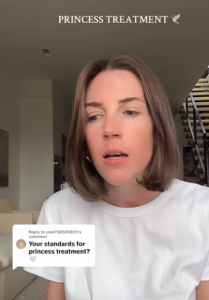
Amanda White, a therapist, speaks to this matter in an interview with the New York Times. White believes that “women had spent the past decade discussing how to address conflict in relationships and be their own advocate,” specifically stating “‘I think it’s concerning to me that there is kind of this shift back.’”
Overall, the moral of this discussion is not that having expectations in a relationship is wrong, just that the harmful undertones of these videos should not be overlooked. When a guideline becomes stricter, it may be time to step away from the screen.
For More Information:
What Is the ‘Princess Treatment’ Debate on TikTok? – The New York Times
This TikTok Mom’s ‘Princess Treatment’ Is Just Emotional Indoctrination in Disguise
Is ‘princess treatment’ a harmless trend – or yet more fuel for misogyny?