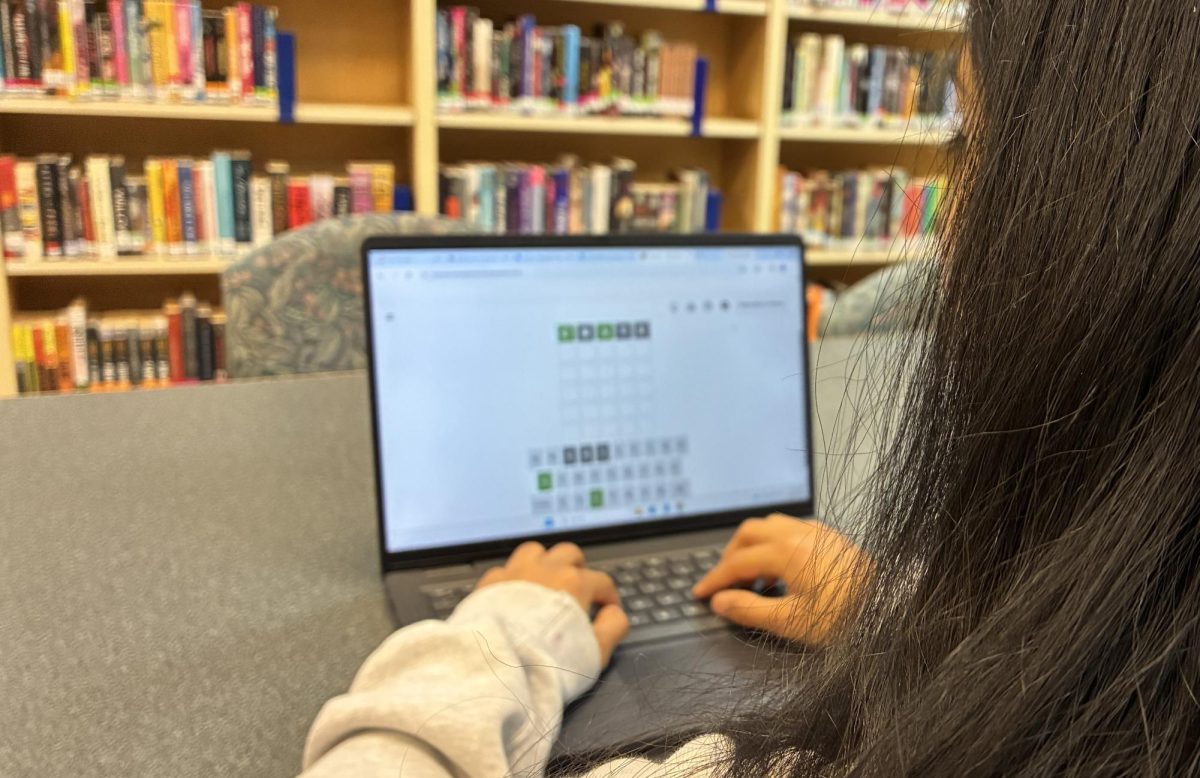
Gaming has become a major part of student culture at Skyline. While some see it as a way to relax in a stressful environment, others worry about the distraction and impact on learning. Students indulge in games that fall under five main categories: blocked, academic, mobile, in-class, and miscellaneous games.
Blocked Games
Blocked games are filtered by the Securly system which sorts either by website category or through a list of individually blocked sites. This makes it difficult for students to access most games in general. Some blocked games include “Shell Shockers,” which for a short time had an unblocked “Shellshock.guru” url, and Polytrack, formerly accessible through a Google Sites page.

Although Securely, Skyline’s computer monitoring extension, continuously updates and blocks games, students persistently find more creative workarounds.
Some students believe there are more effective methods to prevent students from being distracted by games in class.
Sophomore Pranav Karthik said, “Rather than adjusting enforcement, there should be more efforts to get students to focus on their work,” leading to students having “the ability to do what they want,” which he doesn’t think the current policy of “blocking all ‘suspicious’ websites” does.
In addition to Securly’s filtering system, teachers are also able to monitor and lock students’ screens if they find them off task through the Securly Classroom application.
In-Class Teacher Selected Games
These are the games teachers include in their lesson plans, such as Kahoot and Blooket. These games are often used to review course content, especially before exams, offering a more fun way to study and prepare, easing some of the pre-exam stress.

Mobile Games
Another common form of gaming at school is mobile gaming. When students play most mobile games, they are forced to disconnect from the school internet, using their cellular data instead. Common games include: Brawl Stars, Clash Royale, and Among Us.

Game Class
This year, Skyline introduced a new course offering, “Video Game Design with Unity and C#.” Students spend the first semester learning game design, then work together in teams in the second semester to build a full new game.
Video Game Design student Rohan Remany says the class is “fun and unique, as … it is self-paced, so you can learn as much as you want.”
Game Design teacher Adam Hendricks believes that in his class, it is more “fulfilling” for students to create games rather than just play them. “Students should be able to build a game … that would be ready to publish [on a] platform,” preparing them for a potential game development career.
Despite the inspiration and opportunities this class offers, Hendricks has concerns about students spending too much time playing and “researching” games rather than creating them.

Miscellaneous Games
The final category is everything else. Some popular options include the classic game of chess, card games, the viral word and guessing game imposter, as well as New York Times games such as Wordle and Connections.
Some students take on creative and unique approaches for gaming at school. For example, Karthik often plays a “mental math game [he prompted] AI to code as an HTML.”

Why Students Play Games
Students play games for a variety of reasons, from curing boredom to relaxing in a stressful environment.
Sophomore Sizhe Zheng said he “plays games at school to relax and kill time, especially during classes where there isn’t a lot of things to do, or when there is free time after [he] finishes [his] work.”
Game Design teacher Hendricks believes that boredom can actually be beneficial for students.
“I think it is important for students to … have moments of boredom. I find boredom is often a good catalyst to more thoughtfulness and creativity,” said Hendricks.
Teacher Perspective
Playing games during class, especially during instruction time, can be disrespectful to teachers and can make them feel under-appreciated.
Game Design teacher Hendricks said that when students play games in class, “it can feel disrespectful and reflect poorly on perception, … [signaling] a lack of maturity, discipline, and self-control. Additionally, it can lower morale in class when students choose to disengage.”
Each teacher’s tolerance varies. Some may be fine with students playing games after they finish classwork.

Impact of Gaming on Academics
One prominent concern is the impact of gaming at school on academics, as some worry games will diminish in-class work time and distract students from learning.
However, some students find that their academics don’t tend to suffer even though they may sometimes play games.
Karthik said, “I think that given the manner in which I use and play video games, they really have little to no effect on my academics because I make sure to prioritize my learning over temporary enjoyment through a game. I’ve certainly seen many of my peers develop addictions to games, which has definitely shifted their focus and harmed their learning.”
Balancing focus, academics, and respect with gaming remains a struggle for many students.
Ultimately, gaming continues to be a core part of Skyline student culture, serving as a classroom distraction for some and an academic and potential career pathway for others.