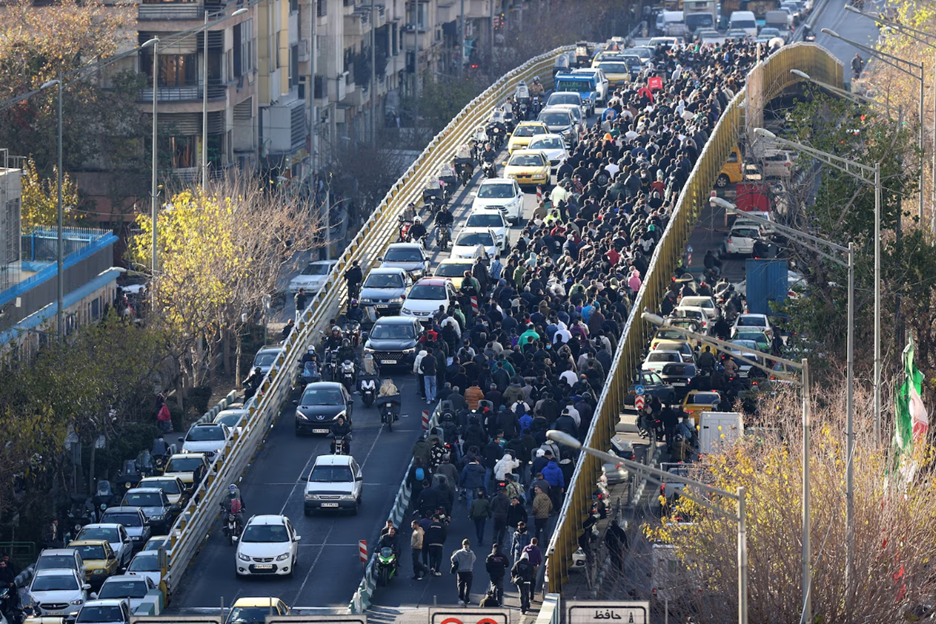
In January, the Iranian Intelligence Organization of the Islamic Revolutionary Guard Corps claimed 36,500 people were killed in ongoing protests that started in December 2025. These are the biggest demonstrations in Iran since 1979, leaving upwards of 330,000 injured and 41,000 arrested. Protesters are calling for the end of the Islamic government and economic mismanagement. A week later, the Human Rights Activists in Iran (HRANA) claimed 6,842 verified protester deaths and 11,280 cases under investigation.
On December 28, 2025, shopkeepers at Tehran’s Alaeddin Shopping Center closed shop and took to the streets to protest the government leadership that led to Iran’s unstable economy. In June 2025, Israel and the United States’ bombing operations targeting Iran in the 12-day war drained the country’s economic resources. On the day protests started, the Iranian Rial dropped to a record low of 1.42 million to the US dollar, resulting in a sharp spike in food and gas prices.

The protests continued into the next day, when shopkeepers at the Grand Bazaar also closed their shops. Demonstrations were largely non-violent at this point, with crowds chanting “freedom” and other phrases against Supreme Leader Ali Khamenei. Law enforcement used tear gas to disperse crowds. By the night of the 29th, protests had spread to many parts of the country, including Zanjan and Hamadan.
The first fatalities were reported at the turn of the year, with “three protesters, including a child, were killed and at least 17 others injured” in Azna, in Iran’s Lorestan Province. Iranian President Masoud Pezeshkian called for the government to take action to improve economic benefits, stating that “From an Islamic perspective … if we do not resolve the issue of people’s livelihoods, we will end up in hell.”
On January 6, the 10th day of protests, a sit-in was organized in Tehran’s Grand Bazaar, with security again dispersing the crowds with tear gas. HRANA reported 35 killed and over 1,200 arrested. The demonstrations spread to 257 locations across 88 cities. Reza Pahlavi, son of Mohammed Reza Shah Pahlavi, the last king of Iran, called for citizens to take to the streets on the evening of January 8 and 9. “Despite the regime’s ongoing violent crackdown, you are resisting, and it is inspiring,” Pahlavi said.
On the evening of the 8th, the time for demonstrations specified by Pahlavi, authorities cut internet access as crackdowns were mounting. Starlink satellite internet was not affected, allowing certain citizens to have access to the web; this lasted until January 11, when authorities successfully jammed at least 80% of Starlink traffic.
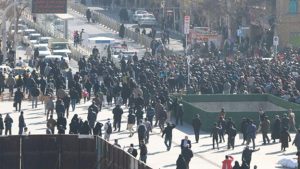
The Iranian government enacted a nationwide curfew in an attempt to curb protests. This resulted in a lull in recorded demonstrations, according to the Institute of the Study of War.
On the night of February 10, anti-government chanting continued as the government planned events on the anniversary of the victory of the 1979 Iranian revolution the next day. Internet disruptions are still ongoing.
The continuing demonstrations show that the majority of the population no longer wants to tolerate the regime any longer, weakening the current government’s legitimacy.
For more information:
Over 36,500 killed in Iran’s deadliest massacre, documents reveal
A timeline of how the protests in Iran unfolded and the crackdown that followed
Here’s What to Know About the Protests in Iran
Day Thirty-Six of the Protests; Government Releases List of Names and State TV Insults Those Killed
Several killed as Iran protests over rising cost of living spread
Iranian security forces clash with protesters at Tehran’s grand bazaar
Iranian protests escalate as authorities cut internet and crackdown intensifies
Iran report says 16,500 dead in ‘genocide under digital darkness’