The Federal Reserve, colloquially known as the Fed, is the U.S. central bank created by the Federal Reserve Act of 1913. It was designed to establish a monetary system that could respond to anything happening in the banking system.
Its main jobs are to maintain national financial stability through policies, regulations, and calculations of important monetary values like interest rates, which are essential to America and the state of the nation. The Fed determines how much extra money you receive from depositing your money in banks, and how much extra you pay for taking out a loan.
When interest rates are high, it means that saving is rewarded and taking out a loan is heavily penalized, incentivizing people to save money. Low interest rates mean saving isn’t as helpful, and borrowing isn’t as harmful, incentivizing people to spend.
However, with many other factors at play in the economy, such as employment levels and inflation, the decisions the Fed makes are extremely complex and require long-term thinking.
The Fed is unique for its political independence. It makes decisions without the approval of anyone in the executive or legislative branches of the government.
Though designed to be politically separate from the government, the presidency and the Fed have often had a hard time separating from one another. Because low interest rates make prices more affordable in the short term, presidents often push for decreased rates to increase approval ratings on the economy, without concern for the economy’s long-term health, which the Fed is responsible for.
For instance, in the 1960s, when Lyndon B. Johnson was president and William McChesney Martin was Fed Chair, Martin and the Fed raised rates to cool the economy. However, President Johnson needed money to fuel the war with Vietnam and many other ambitious programs. A brutal battle ensued. The President won, and rates were lowered. The decision for the Fed to move based on presidential demands led to inflation and fiscal chaos in the 1970s.
Pressure peaked with President Nixon, who privately made the Fed Chair Arthur Burns keep interest rates low for his reelection. When Nixon won, he stepped back into office to see an overstimulated economy that faced brutal years of stagflation, where the economy didn’t grow as inflation did – a cautionary tale for why the Fed must be self-governed.
In the present day, President Trump has changed the normality of the conflict with the Fed. Instead of having clashes behind closed doors, Trump openly conflicts with the Fed. In his first term, Trump appointed the current Fed Chair, Jerome Powell. Since then, a vicious battle has ensued.
In 2018, as the economy heated up, the Fed raised interest rates four times, something Trump was extremely displeased with. In November of 2018, in an interview to the Washington Post, he went so far as to say that the “Fed is a much bigger problem than China.”
Trump reportedly explored whether he could fire Powell and was never satisfied with the three rate cuts that occurred in 2019. The president wanted rates to be zero or even go into the negatives.
Four years out of office did little to resolve the tensions or pressure Trump put on Powell, as Trump again pushed Powell to cut rates and threatened to fire the Chair. As the president deployed a battery of stunts, from aggressive tariff wars to the contentious push to fire Fed governors like Lisa Cook, the pressure on the Fed reached a fever pitch. Despite repeated attempts to rattle or even remove Powell throughout accusations of ‘gross incompetence,” the two remain in a bitter deadlock.
Powell’s term ends in May 2026. He will, however, have the choice to stay on the board for two more years. All eyes are now on Kevin Warsh, a former Fed Governor, who Trump has chosen as Powell’s successor.
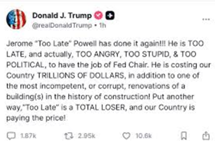
Presidents want cheap, easy money – either because they think it will genuinely help the economy, or because it looks better for them in the short term. The Fed is designed to look further in the future and is the reason for the separation of powers. Can the Fed retain its sovereignty? Or will Trump and the presidents after him overpower the Fed and America’s monetary decisions?
For more information:
The Federal Reserve Explained
1965: The Year the Fed and LBJ Clashed
What to Know about Trump’s Ugly Feud with the Federal Reserve