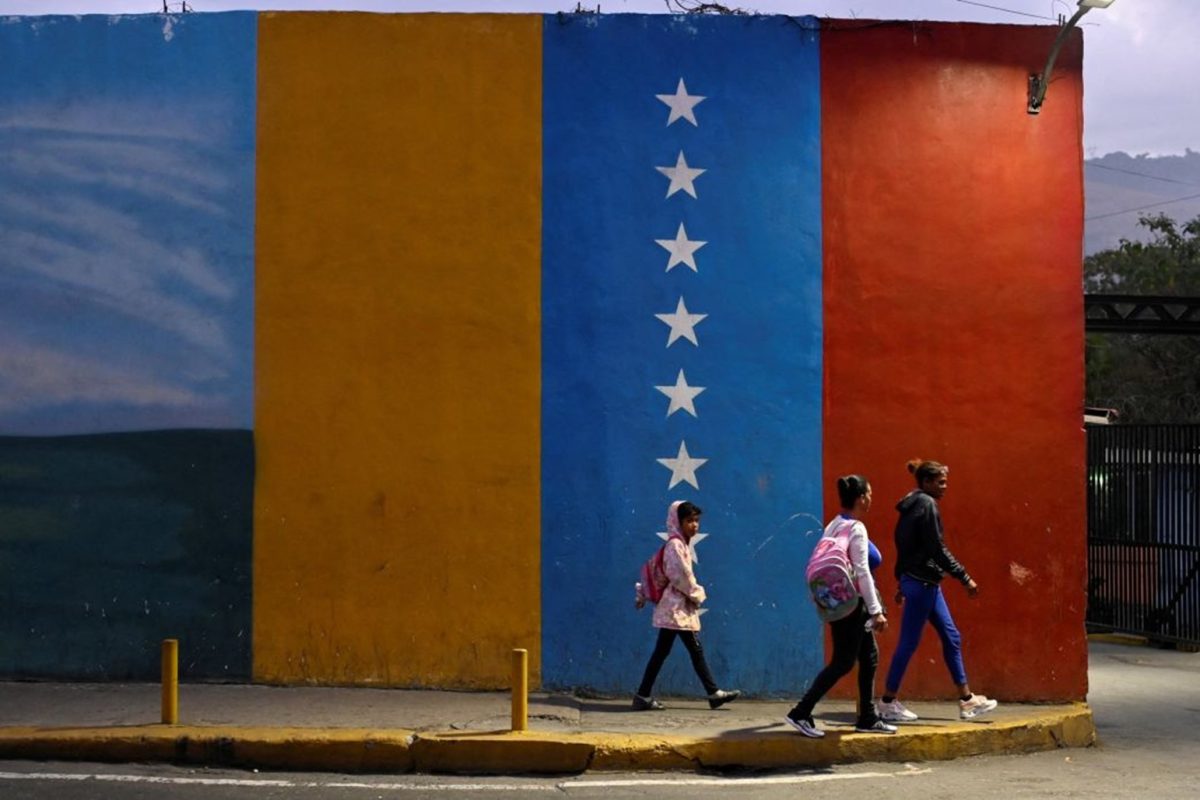
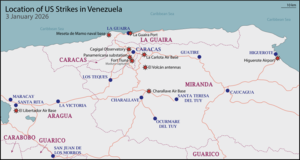
On the evening of January 2, 2026, the United States launched airstrikes on military bases and economic targets in Venezuela. This was followed up by an operation by the U.S. Army, reportedly on the military compound at Fort Tiuna, that resulted in the capture of Venezuelan President Nicolás Maduro and his wife Cilia Flores and their detention in the U.S.
Immediately after the attack, international leaders denounced the operation as a violation of international law, especially among countries already at odds with the U.S., such as China and Iran, but also among many Latin American countries (of which Brazil, Chile, Colombia, Mexico, and Uruguay, along with Spain, issued a joint statement condemning the attack).
Both U.N. Secretary-General António Guterres and European Union foreign policy chief Kaja Kallas also issued statements, supported by member nations, in the wake of the intervention calling on said international law to be respected.
However, among other nations, the downfall of Maduro’s dictatorial regime was celebrated, with Israel, Argentina, and several European countries, notably including the United Kingdom and Germany, supporting Maduro’s removal, though many of them also expressed concern over the U.S.’s violation of Venezuelan sovereignty.
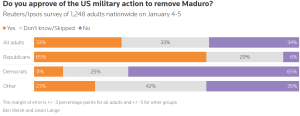
Among the general public, there has also been support for the operation within certain groups, most famously the Venezuelan diaspora and political opposition. In the U.S., support for the invasion has been broken down among party lines, as a Reuters survey conducted within a few days of the attack showed support from 65% of Republicans, compared to support from 11% of Democrats and 23% of Independents/Other.
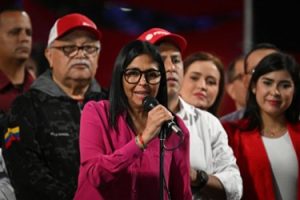
Even after Maduro’s capture, his existing government remains in power under the leadership of Vice President Delcy Rodriguez, who was sworn in as interim President on January 5; the Venezuelan government has maintained that Maduro is still the incumbent president. Rodriguez has continued opposition to American intervention, stating “…[The Venezuelans] will never again be a colony of any empire…”, and ordering the arrests of anyone supporting the U.S. invasion, detaining 14 journalists among others.
Starting January 8, Rodriguez’s government began releasing political prisoners dating back to 1999, imprisoned under the Maduro, and the previous Hugo Cháves administrations. As of January 30, 302 prisoners were confirmed to be released.
This intervention has been another facet in Trump’s recent policy of aggressive interventionism, which he has himself referred to as the “Donroe Doctrine”, where America has, at times forcefully, attempted to secure mercantile and political dominance over the Western Hemisphere. This has also come with attempts to occupy the Danish territory of Greenland, despite the latter’s continued opposition to its sale or occupation, and the diplomatic conflict is still ongoing.
On January 3, Trump, when speaking to the press, announced his intention for the U.S. to “…run the country…”, going on to say that the U.S. and American companies would take over the country’s oil industry. However, the former statement was formally retracted the next day by Secretary of State Marco Rubio, though the U.S. reiterated its intention to be involved in the Venezuelan oil industry.
America has since indicated a willingness to cooperate with Rodriguez’s government in a transition period to democracy, with U.S. involvement being mostly limited to its oil industry. However, in a CNN interview, Venezuelan political expert Benigno Alarcón stated that “the transition has not truly begun [After a month]”, and that the Rodriguez administration is not keen on holding elections and losing power, while the opposition has not taken any notable action in the country to hold Rodriguez to the transition, leaving the fate of Venezuela in flux.
For more information:
Delcy Rodriguez Statement
How the World Is Reacting to the U.S. Capture of Nicolas Maduro
Reuters Poll
Transcript of Trump Interview
The US says Venezuela is changing…