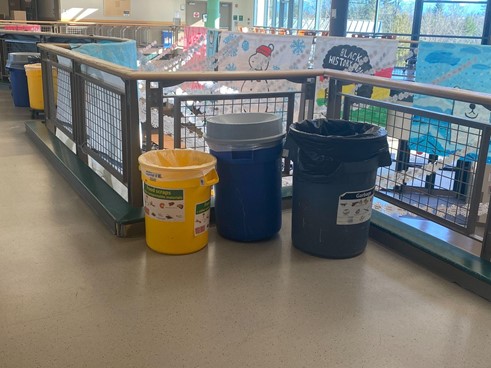
Skyline’s compost management is ineffective. Skyline custodian Jeannette Blendermann shares this sentiment, but believes Skyline can take actions to repair its broken waste system.
According to King County’s Green Schools Program, Skyline High School is a “Success Story,” meeting benchmarks for waste reduction, energy conservation, and water conservation. It achieved the benchmark for waste reduction in May 2013, following the school’s increased collection of compostable and recyclable materials.
Skyline’s sustainability status was reaffirmed in 2023 when the district awarded it the title “Sustaining Green School.”
Despite the recognition Skyline has received from King County for its waste-reduction efforts, custodian Blendermann noted deficiencies in the school’s composting.
“Oh, composting. Well, it doesn’t work very well,” Blendermann said in an interview with The Spartan Forum.
“And the reason, right here, is the problem. These are not compostable bags,” she said holding the white liner of the compost bin in her hand.
Previously, the Issaquah School District had used the typical green compostable liners in compost bins. Now, non-compostable trash bags line compost bins across the district.
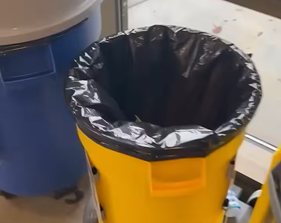
Due to the use of trash bags, the compost inside would have to be manually dumped into the compost bin. Doing this is not feasible for custodians, resulting in much of Skyline’s compost ending up in the trash.
“We can’t take the time to sit there and empty each bag. So most of the custodians have to end up throwing it,” Blendermann said. “We don’t have the correct bags. So we almost have a zero end result because of that.”
Given the district’s reluctance to allocate funds for compostable liners, Blendermann is calling on individual schools to raise money for them.
Blendermann also identified sorting as an issue the school faces, as items end up in the wrong bins. She noted that improper sorting goes both ways: trash often ends up in the compost, and compostable items often end up in the trash.
Regarding sorting, Blendermann suggested having waste management professionals at schools to educate students and staff.
“Have trash management companies come in and explain [how to sort waste], right?” Blendermann said. “I’m not saying that anybody’s lazy. We just don’t know.”
Akanksha Ayyadevara, a senior and Vice President of the Green Team at Skyline, was on board with Blenderman’s idea. Ayyadevara specifically suggested calling people from YMCA’s Earth Service Corps, a youth-led sustainability program, to teach Skyline students and staff how to properly sort waste.
“Another thing that would be helpful to improve waste management is conducting a waste audit at Skyline,” said Ayyadevara.

A “waste audit” entails collecting and sorting a sample of the school’s compost and recycling to gauge how accurately items are being disposed of. Performing an audit would give Skyline a benchmark for how well waste is being sorted.
Waste management has always been a priority of Skyline Green Team, which focuses on how sustainability can be incorporated into daily life.
“I think there’s a lot of work Skyline can do to improve their composting and waste management, because not only is it hard to compost because of the non-compostable trash bags, but Skyline students are not always aware of what should be composted and what shouldn’t,” Ayyadevara said.
For more information:
King County Green Schools: Skyline High School
STUDENT TAKEOVER: A Day in the Life at Issaquah High School!